
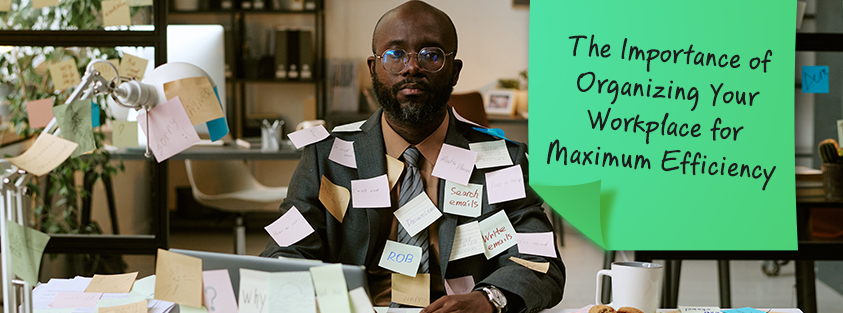
How Staying Organized at Work Pays Off in the Long-Term
Organizing your workplace isn’t something that you should do just for the sake of keeping tidy; it’s something that you should do to stay productive on the job. Disorganized employees lose real work time searching for files and documents, which results in less work being done each day. In addition, the stress caused by having a cluttered desk can create spikes in cortisol, which can result in an afternoon burnout. This leaves workers feeling unmotivated and exhausted well before the workday is done.
Beyond individual well-being, workspace clutter can also create blocked walkways and fire hazards, leading to genuine safety issues. Clutter also undermines the professional image clients see when they walk through your door or hop on a video call. Staying organized isn’t just some chore; it’s an investment that results in improved productivity and better well-being. By implementing simple systems, like labeled storage and digital filing, and performing daily desk resets, you will reap the benefits of workplace organization in no time.
Read on to see some of the reasons why workplace organization matters and learn five tips that will help you stay organized at the office.
4 Ways an Organized Office Benefits You and Your Business
More Time for Productive Work
According to a study by the Princeton University Neuroscience Institute, cluttered workspaces make it harder to concentrate and process information. This is because clutter forces the brain to divert attention to multiple items, and your attention becomes scattered as a result. This makes it harder to focus on the task at hand, and your ability to make crucial decisions slows down dramatically. Even worse, regaining your focus after a single interruption can take over 23 minutes on average, according to UC Berkely. All in all, cluttered workspaces cost the average worker between 30-60 minutes of work a day, or 3.3 hours a week. Nearly half of all workers spend over an hour each day searching for files or data
It doesn’t have to be this way. Simple organizational tricks, like using filing and storage systems, will cut this wasted search time significantly and cut down on clutter. This in turn makes it easier for us to focus on what we need to get done.
Less Stress, Better Mental and Physical Health
According to research at DePaul University’s College of Science and Health, cluttered work environments are linked to elevated cortisol, the body’s stress hormone.
Visual clutter adds to your cognitive load and becomes a driving force behind mental fatigue and anxiety. It even increases levels of self-criticism. The North American Journal of Psychology backs this up, noting that — putting it bluntly – clutter forces competition for our brain’s attention and basically drags down our productive capacity. Remote workers aren’t immune to this either, as employee-related behaviors are adversely affected by clutter at home as well.
By keeping your desk tidy, you will not only have a more focused state of mind as you work. You will also find yourself in a better mood throughout the day, leading to improved motivation as you work.
A Healthier Work Environment Overall
Clutter isn’t just poor for our mental health; it’s also a real safety risk. In fact, according to a 2023 report from OSHA, clutter is a leading cause of slip, trip, and fall injuries in the workplace. Office clutter causes nearly 700 workplace fatalities per year and costs companies millions of dollars in lawsuits.
Blocked walkways and massive paper piles also increase fire risks and make evacuations difficult in real emergencies. Plus, messy spaces make it easier for germs to fester, which can result in multiple sick days. All in all, clutter is not great for the health and safety of your employees, nor is it good for employee morale.
Want to know a simple way to avoid these sorts of risks in your office? Keep your workspace decluttered by doing basic routine organization and daily cleaning. This keeps your workplace safer and helps to reduce germs, resulting in fewer sick days.
A Positive Impression on Clients
We know the saying: you don’t get a second chance to make a good first impression. That goes doubly so for the cleanliness and overall appearance of your office. According to PwC’s Trust in Business Survey, a clean, organized space builds visiting clients’ trust and confidence. First impressions of your workspace shape how clients judge your business. If a client walks into a workspace that is messy and chaotic, they will immediately think less of the business out of the gate. Clutter is seen as a sign of disorganization, while a tidy work environment is a sign of professionalism, so organizing your workplace is of the utmost importance.
5 Tips for Staying Organized at Work
Organizing your workplace is a lot easier than you might think. The following are a few simple tools to help you kick clutter to the curb.
- Reset your desk daily: End each day with a 5-minute “shutdown ritual.” Clear off surfaces, file away any loose papers, and mark your priorities for the next day. A desktop tray or sorter (like a 3-tier inbox) keeps this process fast and habitual.
- Digitize your paperwork: Scan documents with an app like Adobe Scan and store them in labeled cloud folders (like Google Drive or Dropbox). This cuts down on the 4+ hours a week many workers spend hunting through paper.
- Label everything: A label maker turns drawers, binders, and shelves into a system anyone on the team can navigate without asking around.
- Time block your tasks: Use a digital tool or a simple paper planner, to assign specific hours to specific work. This reduces the context-switching that clutter and disorganization make worse.
- Tame your cables and surfaces: Under-desk cable organizers and a monitor stand with built-in storage free up desk space, cutting visual clutter that drains focus over the course of the day.